
Genesis

“I did not appreciate the degree to which Chicago created the river just as surely as the river itself was the genesis for Chicago”
– Libby Hill, The Chicago River: A Natural and Unnatural History1
Prologue
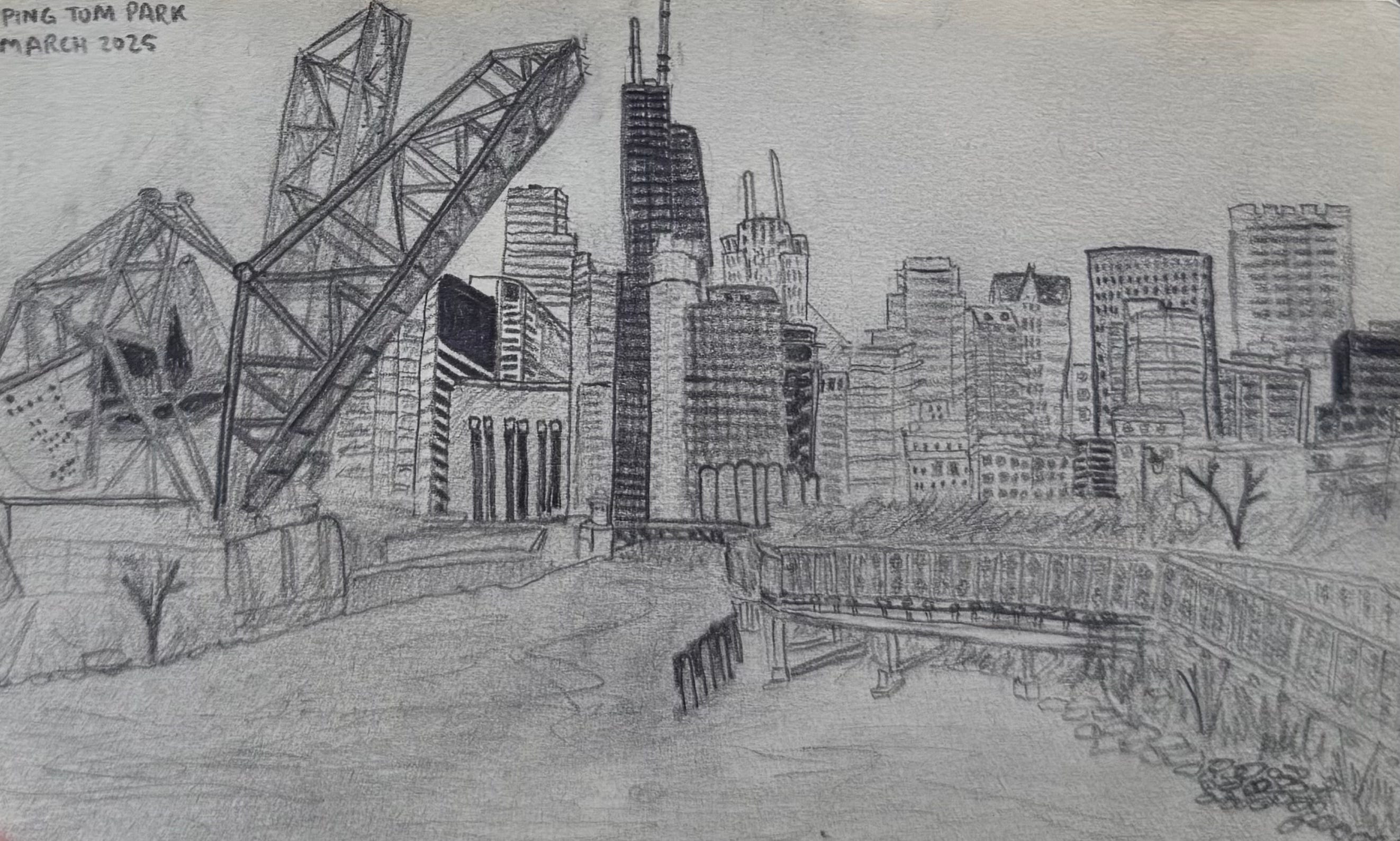
A couple months ago, I was sketching in Ping Tom Park. I had recently gotten laid off after the federal government imploded (thanks Elon!) and wasn’t really sure what to do with myself. So I took the red line down to Chinatown in freezing weather and spent a couple of hours looking at my favorite view of the city.
I have zero artistic training, but I don’t think you really need that to draw. All you have to do is sit and observe. When you do, you start to notice the little details you might otherwise miss – the ornate patterns in a handrail, the swaying sedges by the riverside, the concrete slabs of a bridge abutment that double as home to a particularly annoyed Canada goose.
I’ve always loved this particular view because it tells such a romantic story about the city’s history. There’s the skyline itself – a testament to Chicago’s resilience after the Great Fire, rebuilt with skyscrapers whose architectural styles evolved with the city, from the Art Deco of the 1920s to the modernism of the Sears Tower. Then there’s the St. Charles Airline Bridge – one of Chicago’s iconic early 20th century heel-trunnion bascule bridges – designed to accommodate a rapidly growing population, supporting both rail and barge traffic that fueled the city’s rise as an industrial hub. Even Ping Tom Park, built in 1999 on the site of a former railroad yard in a century-old immigrant neighborhood, reflects this layered history – an attempt to reclaim the riverfront for a community long deprived of green space.
In a way, in one quick (and admittedly rough) sketch, I accidentally captured centuries’ worth of dreams: of people who crossed an ocean in search of a better life for their families, of the resilience of a city that rebuilt itself in the aftermath of tragedy, and of the ambitions of those who built and created where humanity had never reached before. These dreams – both physically and symbolically – have always been intertwined with the river.
So like many bored men in their twenties before me, I decided to start a blog to explore more of these thoughts (after encouragement from my friends Vyasa and Saketh, two bored men in their twenties with their own blogs).
I want to tell a story about the Chicago River – but not a neat one with a clean beginning and end. I think it’ll be more like a series of vignettes: slices of life in the city of Chicago that trace the deep connection between the river, the city, and the people who came from all over the world (much like myself) to call it home.
I’m no expert on Chicago, so this is also a kind of public journal – tracking what I’m reading about how to design equitable, climate-resilient, and ecologically vibrant cities that foster community and feel like home. I might also just write about things I find interesting, like why the winds off of Lake Michigan make Wrigley Field a pitcher’s worst nightmare, how Chicago’s music scene has been shaped by the river, or the wildlife that have been reintroduced to the river as water quality improves.
In a way, this is a love letter to my favorite place in the world – from someone who wasn’t born here, but got here as fast as he could.
So how do you begin a story about a river?
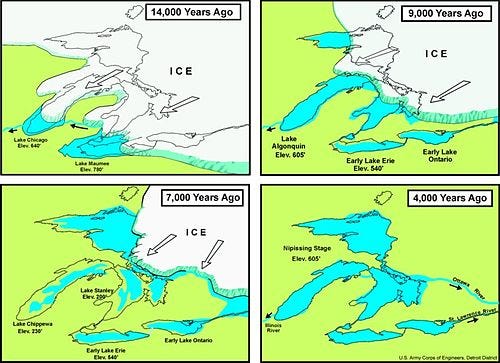
I could take a page (literally) from river historian Libby Hill and start at the very beginning – approximately 400 million years ago – when the Chicagoland area was a vast tropical sea and coral reef, layered over limestone dolomite bedrock. Then, near the end of the last Ice Age, around 8,000 BCE, the Wisconsin glaciation retreated northward, forming prehistoric Lake Chicago from its meltwaters (which would eventually become Lake Michigan). The lake periodically spilled over the Valparaiso Moraine and carved out an ancient stream bed that would become the Chicago Portage—a swampy wetland linking Lake Michigan with the Mississippi River.
Skip a few millennia, and along come Father Jacques Marquette and Louis Jolliet, two French explorers returning from a mapping expedition along the Mississippi River. Marquette and Jolliet were tipped off about a shortcut to the Great Lakes by the Kaskaskia people, who had used the portage for centuries. Suddenly, the stage was set for a great American metropolis that could connect the two major transportation networks of the North American continent.
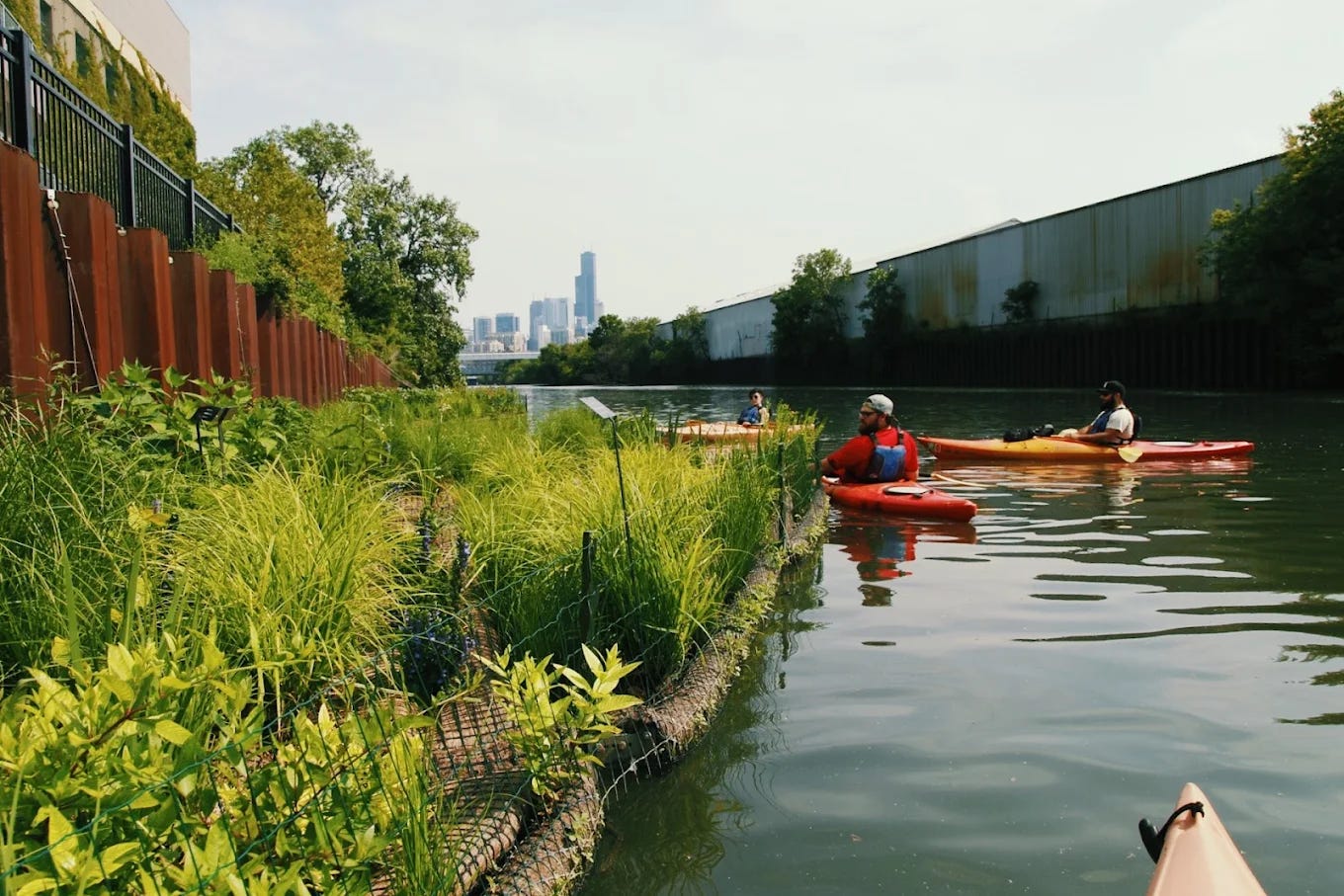
Another option would be to borrow from Elizabeth Kolbert2 and start in the present with the deindustrialization of the river, as neighborhoods shift from rows of smoke-covered factories and warehouses to quaint residential areas and commercial real estate shaped by a tech-driven economy. The barge traffic declines and and the pollution that once defined Chicago’s waterways begins to lift. Nonprofits such as Friends of the Chicago River and Urban Rivers lead the charge to reclaim these heavily engineered waterways through restoring natural habitat, creating urban green space for communities to safely interact with and appreciate the historically maligned river.
Or, I could start with the reference from this blog’s title (shoutout to my friend Madison for the name idea). As in the Book of Genesis, Chicago’s history can be written as a story about attempted dominion over the earth through the engineering of the river – beginning with the the 1900 completion of the Chicago Sanitary & Ship Canal. One of the greatest civil engineering feats in American history, the canal reversed the flow of the river to redirect polluted water away from the city’s drinking water source in Lake Michigan and toward the Mississippi instead.
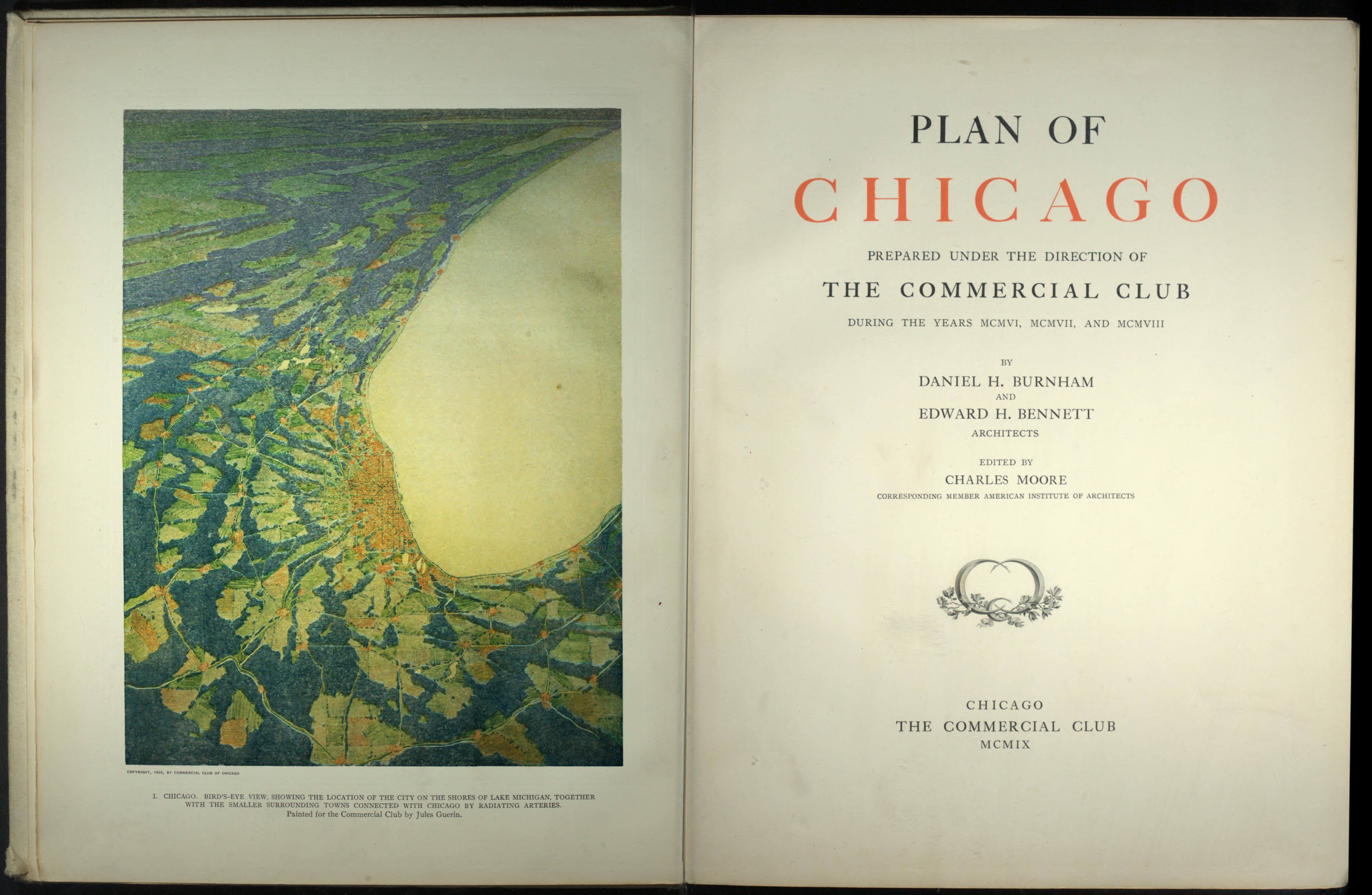
But instead, I think I’ll start somewhere in the middle – 1909, to be specific – when Daniel Burnham and Edward Bennett published the Plan of Chicago and set the blueprint for the modern American city.3
A City Beautiful
“The prototype of the city-as-process, Chicago’s phenomenal growth is the great urban romance of the modern world.”
– Architectural Review, October 1977
In the latter half of the 19th century, Chicago’s population was rapidly expanding alongside river and train transportation routes – and the industries that developed with them. In 1870, the population was around 300,000 people. By 1900, the population had reached 1.7 million, a nearly six-fold increase in just three decades.
As the city grew, a group of businessmen at the Commercial Club of Chicago recognized the need for a coordinated vision to guide urban development and improve municipal services to meet the needs of Chicago’s rapidly growing population. They turned to Daniel Burnham, the architect behind the 1893 World’s Columbian Exposition in Jackson Park.
In some ways, this was antithetical to the spirit of Chicago’s rise. As the Architectural Review suggests in a great 1977 editorial, “Chicago was as successful as she was because she gave free rein to her most active citizens to build where they liked, what they liked.” So how do you guide this growth to create a desirable and habitable city without destroying the chaotic, entrepreneurial energy that had fueled its rapid ascension?
Burnham’s answer was deceptively simple: if the city is beautiful, people will want to invest and do business in it. From that idea emerged the Plan of Chicago – a pioneering document of the City Beautiful movement. The plan re-imagined the American city as more than just a hub for free market capitalism and chaotic growth, but instead as a beautiful, desirable common space that fostered civic and cultural flourishing. This urban philosophy – just as conservative as it was forward-looking – drew heavily from the Neoclassicism of Paris and proposed grand monuments, beautiful parks, and a reclaimed lakefront as a public amenity for the city.
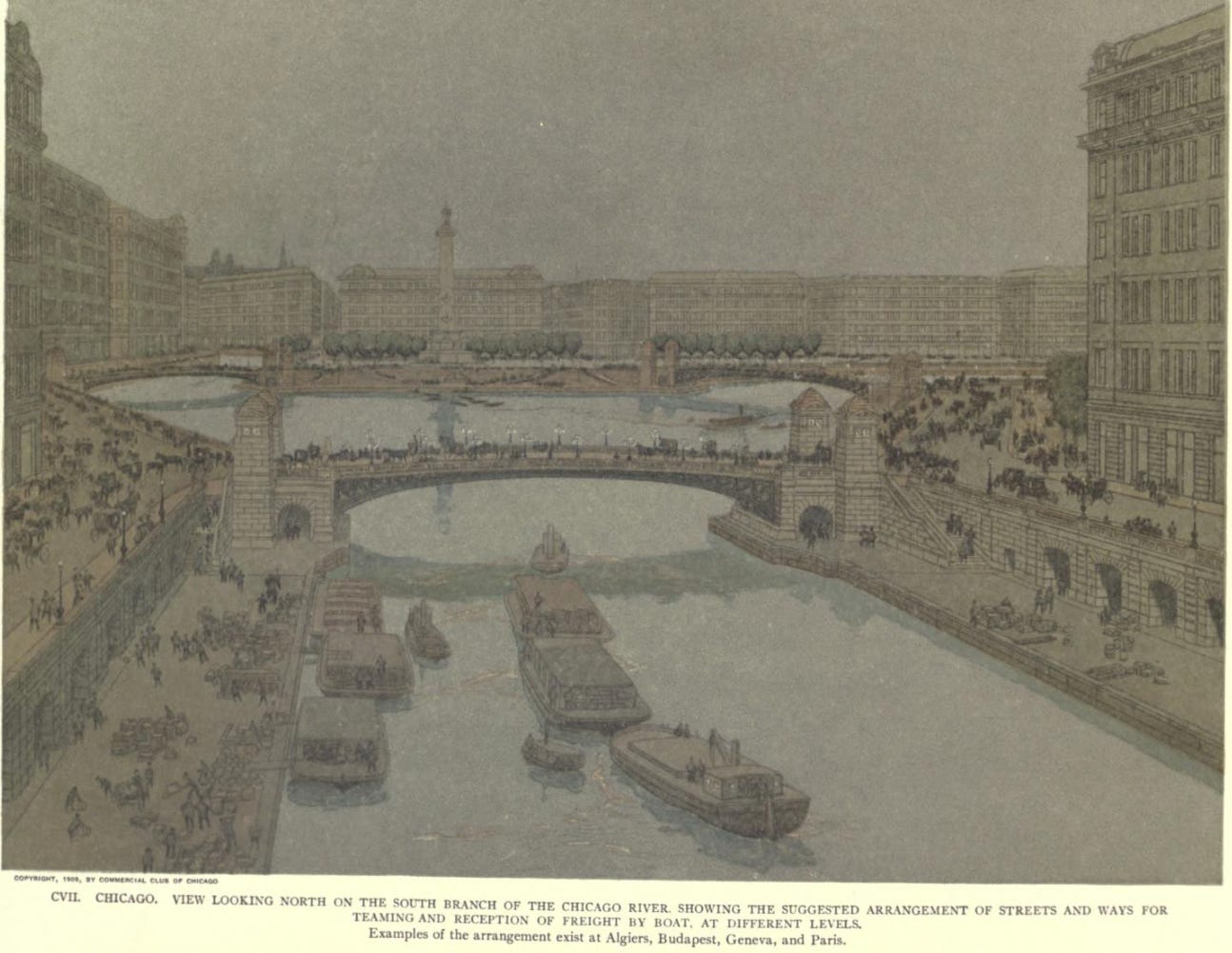
“Was it possible not only to determine the direction of urban experience, but also to make a major correction? … Might economic interests, the public good, and personal needs be reconciled? And could Chicago even become not just equal but superior to any other great city of the world, past or present?”
– Carl Smith, The Plan of Chicago: Daniel Burnham and the Remaking of the American City4
I’ll save a detailed discussion of Burnham’s proposals for another blog, since many are outside the scope of the river. But I think everyone should read the Plan of Chicago at some point. If nothing else, it’s a stunning vision for what cities can look like, illustrated by gorgeous visuals from Jules Guérin and driven by Burnham’s famous belief that Chicago should “make no little plans.”
The entire second chapter is a love letter to the great cities of history, exploring how they used large-scale infrastructure projects to shape urban growth. Athens under Pericles built beautiful public buildings such as the Acropolis to foster civic pride. Rome’s parks, gardens, and public squares were designed ensured the health and general wellbeing of the city’s inhabitants. Burnham was especially enamored by Paris, praising the foresight of Louis XIV for extending central avenues beyond the city;s limits into the open countryside – land that would later become home to iconic landmarks such as the Place de la Concorde and the Jardin des Tulieres.
In Burnham’s bold view, Chicago’s rise to join the ranks of these great cities wasn’t just possible – it was inevitable. But it would require radical thinking on how to design a city that would meet the needs of future generations.
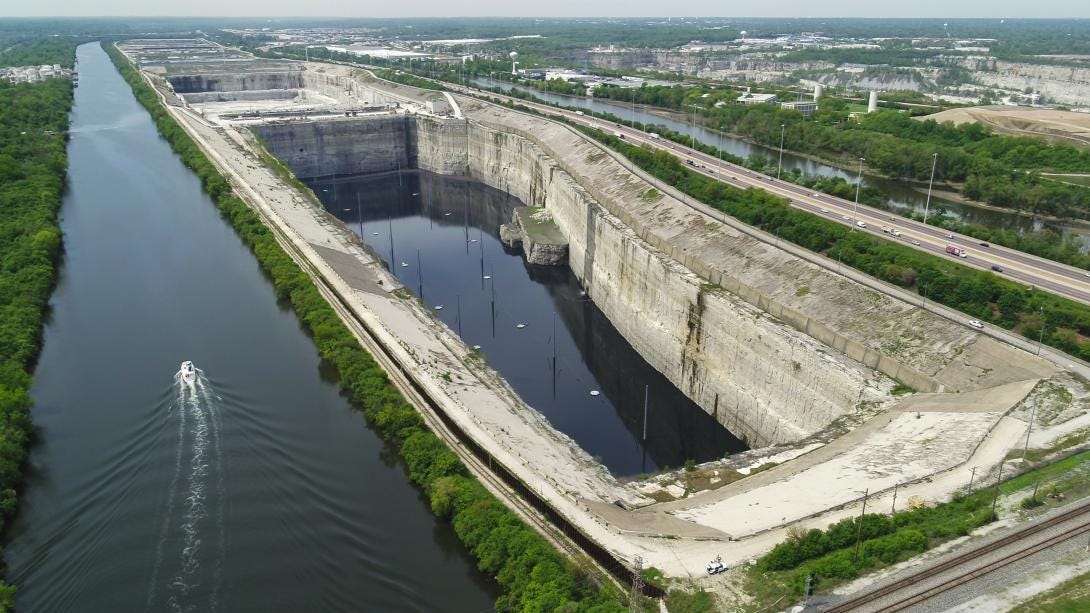
While many of Burnham’s ideas never came to life, his core philosophy – urban planning as a bold, forward-thinking act – still resonates today. I think one of the best modern examples of this is the $3.8B Tunnel and Reservoir Plan (TARP), which prevents combined sewer overflows by capturing excess sewage and storm water in massive reservoirs for later treatment, rather than discharging it into the river. Initiated in 1975 and expected to be completed by 2029, TARP reflects the exact type of long-term thinking Burnham championed: an investment made not for the city of its time, but in hopes that future generations could one day experience a safer Chicago River. Today, the gradual decrease in raw sewage outflows to the river under TARP has played a huge role in improving water quality along the river – transforming what Burnham once described as “a dumping spot and cesspool” into a recreational amenity, repopulated by aquatic life and enjoyed by hundreds of thousands of Chicagoans each year.
However, one of the main issues with Burnham’s plan was its reliance on the somewhat simplistic belief that a better aesthetic environment would naturally improve social outcomes along the river. In doing so, it seemingly overlooked the drivers of poverty, congestion, and poor sanitation – the very ugliness the city was trying to escape.5
A City… Less Beautiful
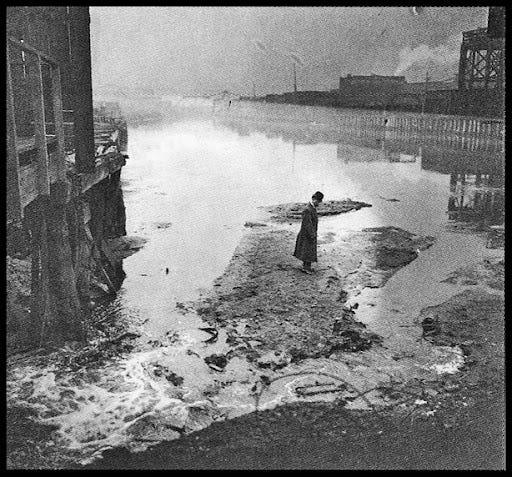
"‘Bubbly Creek’ is an arm of the Chicago River, and forms the southern boundary of the yards: all the drainage of the square mile of packing houses empties into it, so that it is really a great open sewer a hundred or two feet wide. One long arm of it is blind, and the filth stays there forever and a day. The grease and chemicals that are poured into it undergo all sorts of strange transformations, which are the cause of its name... Here and there the grease and filth have caked solid, and the creek looks like a bed of lava; chickens walk about on it, feeding, and many times an unwary stranger has started to stroll across, and vanished temporarily.”
– Upton Sinclair, The Jungle6
At the turn of the century, roughly four in five residents were either first or second-generation immigrants, working on public works projects or in river-adjacent industries such as iron and steel, meatpacking, printing, or railroad construction. These immigrant laborers lived in crowded and cheap dwellings in river wards located close to work sites, forming communities with people of similar ethnic or religious backgrounds.
These river wards had atrocious living conditions, with poor sanitation and frequent outbreaks of water-borne diseases such as cholera. In 1901, Robert Hunter published Tenement Conditions in Chicago, describing the south branch of the Chicago River as a “ditch which accumulates a great deal of sewage from the stock yards, and fills the air with poisonous odors.”7 Hunter presented a detailed analysis of living conditions for the three hundred thousand people living in river wards. He noted that river wards had mortality rates nearly double those of non-river wards and argued that these deaths were largely due to the “abominable” sanitary conditions. This was further expanded on in literature such as Upton Sinclair’s 1906 novel The Jungle, which depicted the hardships and dangerous conditions of immigrant laborers working in the meatpacking industry in Chicago.
This image of Chicago presented a grittier and more cynical alternative to Burnham’s City Beautiful, one that couldn’t be simply swept away through a “Paris on the Prairie.” In her 1961 book The Death and Life of Great American Cities, Jane Jacobs rejected the grandeur of the City Beautiful movement8. She later called it an “architectural design cult,” echoing critics who claimed it ignored the root causes of poverty for superficial, aesthetically motivated monuments.
To paraphrase Carl Smith, these writers – Burnham, Sinclair, Hunter, and Jacobs – all seemed to agree on the problems Chicago faced at the turn of the century, but they disagreed on the way forward. Ultimately, they all were wrestling with the same question: how do we make the urban experience more livable and desirable without crushing the city’s spirit, or ignoring the basic human needs that drive its present-day ugliness?
I think this is a really interesting way to open up a conversation about a river. In the north and central parts of the city, air and water quality have dramatically cleaned up over the past few decades – Smokey Hollow, named after the thick smog from its numerous factories, has now turned into the upscale neighborhood we call River North.
However, this isn’t the case all over the city, as manufacturing and industry has shifted to cheaper real estate in the south and western parts of the city. Consider Little Village on the southwest side, where a quarter-mile stretch of water adjacent to the Chicago Sanitary and Ship Canal has a “putrid smell” and is heavily polluted by carcinogens and heavy metals. In February 2024, the Environmental Protection Agency agreed to investigate whether the waterway should be cleaned up under the Superfund program for hazardous waste sites. Seems pretty clear that we still have a long way to go before reaching the goal of safe access to urban waterways for all.
I still think Burnham was right about a lot of things and I admire his forward thinking and belief in what Chicago can be – but how do we dream big and push forward ideas for urban waterways without brushing aside issues of equity and environmental justice?
The good news is that a lot of smart and hardworking people are trying to answer those questions right now. City officials and nonprofits like Urban Rivers and Friends of the Chicago River are regularly exploring opportunities to restore urban green space across all of Chicago, including through innovative methods such as floating wetlands, which restore natural habitat to harsh seawalls that separate communities from the river and gradually improve water quality through native plants that naturally filter pollutants.9
I’m excited to continue writing about these ideas and more in future posts. Thanks if you got this far – let me know if there are any topics you’d like me to write about in the future!
Hill, Libby. The Chicago River: A Natural and Unnatural History. Revised edition, Southern Illinois University Press, 2019
Kolbert, Elizabeth. Under a White Sky: The Nature of the Future. Crown trade paperback edition. Crown, 2022.
Burnham, Daniel H., and Edward H. Bennett. Plan of Chicago. Illustrated by Jules Guerin, The Commercial Club, 1909. Accessed: https://archive.org/details/planofchicago00burnuoft/page/1/mode/1up
Smith, Carl S. The Plan of Chicago: Daniel Burnham and the Remaking of the American City. University of Chicago Press, 2006.
Burnham actually wrote extensively on social needs in earlier drafts of the plan. Perhaps due to the wealthy clientele it was prepared for, these didn’t appear in the final version.
Sinclair, Upton. The Jungle. Doubleday, Page & Company, 1906.
Hunter, Robert. Tenement Conditions in Chicago. City Homes Association, 1901. Accessed: https://ia601800.us.archive.org/7/items/tenementconditio00city/tenementconditio00city.pdf
Jacobs, Jane. The Death and Life of Great American Cities. Random House, 1961.
If you’re interested in learning more about this (and I will certainly talk about these in later blogs) you can take a look at planning documents such as the Chicago River Corridor Development Plan, Wild Mile Framework, Chicago Central Area Plan, and Our Great Rivers.
My favorite publication on the planet
This is fire excited to read 😘